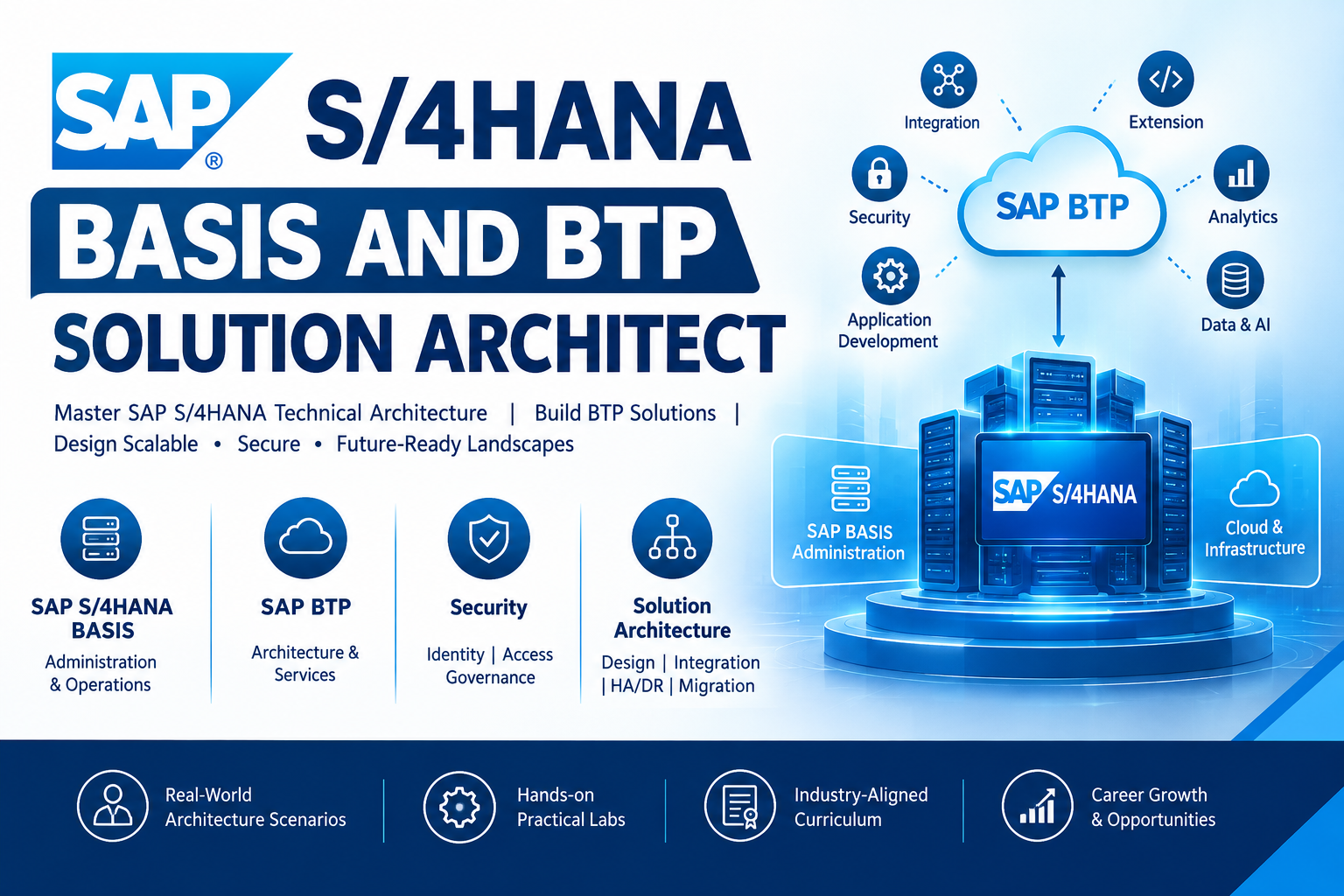
SAP S4HANA BASIS and BTP SOLUTION ARCHITECT
Master SAP S/4HANA BASIS with BTP Solution Architecture, covering enterprise architecture, cloud integration, security, high availability, scalability, and end-to-end SAP landscape design. Build the expertise to architect, govern, and transform modern SAP S/4HANA and SAP BTP environments aligned with enterprise business requirements.
Course Description
SAP S/4HANA BASIS & BTP SOLUTION ARCHITECT
Enterprise SAP Technical Architecture | S/4HANA Administration | BTP | Cloud | Security | Integration | Solution Architecture
Course Overview
The SAP S/4HANA BASIS & BTP Solution Architect Program is an advanced, industry-oriented technical architecture program designed for SAP BASIS professionals, technical consultants, system administrators, cloud professionals, and experienced IT professionals who want to progress from traditional SAP administration into SAP S/4HANA technical architecture and SAP Business Technology Platform (BTP) solution architecture.
The program combines SAP S/4HANA BASIS administration, HANA database architecture, SAP cloud technologies, BTP architecture, security, integration, high availability, disaster recovery, enterprise architecture, migration, implementation governance, and solution design into one comprehensive learning journey.
Rather than focusing only on transaction-level BASIS administration, this program develops the architectural mindset required to understand how SAP landscapes are designed, integrated, secured, migrated, operated, governed, and optimized across on-premise, private cloud, and SAP BTP environments.
Participants work through practical architecture scenarios and implementation-oriented exercises covering the complete SAP technical landscape from infrastructure and S/4HANA system architecture to cloud integration, BTP services, security, HA/DR, migration, and enterprise solution design.
What You Will Learn
Course Curriculum
19 Sections- SAP
S/4HANA architecture and system landscape
- SAP
HANA database architecture and in-memory computing
- SAP
S/4HANA deployment models: On-Premise, Private Cloud & Public Cloud
- SAP
Fiori, SAP Gateway and OData architecture
- SAP
Central Services and Application Server architecture
- System
sizing and capacity planning
- SAP
technical architecture standards
- SAP
Cloud ERP transformation concepts
- RISE
with SAP architecture fundamentals
- Greenfield, Brownfield and Selective Data Transition
- SAP Clean Core principles
- SAP
NetWeaver & S/4HANA technical administration
- ABAP
application server architecture
- SAP
instance and system profiles
- Start/stop
and operational administration
- Work
processes and dispatcher architecture
- Background
job administration
- Spool
and printing administration
- SAP
Gateway administration
- RFC,
trusted RFC and logical systems
- Transport
Management System- TMS
- Client
administration and system copies
- SAP
kernel management
- Software
Component Versions and add-ons
- SAP
HANA architecture
- HANA
tenant and system database concepts
- HANA
Cloud vs SAP HANA Platform
- HANA
installation and configuration
- HANA
memory management
- Backup
and recovery architecture
- Database
monitoring and troubleshooting
- SQL
performance fundamentals
- HANA
high availability
- HANA
System Replication
- Data
volume and log volume management
- HANA security and auditing
- Performance optimization
- Application-server
performance analysis
- HANA
performance analysis
- SQL
monitoring and optimization
- Expensive
SQL statements
- ST03N,
ST12, ST05 and SAT analysis
- Work-process
bottleneck analysis
- Memory
and CPU troubleshooting
- SAP
EarlyWatch concepts
- Performance
baseline creation
- Capacity
planning
- Root Cause Analysis methodology
- Enterprise performance governance
- SAP
Fiori architecture
- Fiori
Launchpad
- SAPUI5
fundamentals for BASIS architects
- SAP
Gateway architecture
- OData
services
- Catalogs,
spaces and pages
- Role-based
access
- Fiori
troubleshooting
- Front-end
and back-end server architecture
- SSO
integration
- Fiori
deployment and lifecycle management
- SAP
security architecture
- Authentication
and authorization concepts
- SAP
roles and authorization objects
- User
administration
- SSO
and Identity Federation
- SAML
2.0 concepts
- X.509
certificates
- SSL/TLS
configuration
- SAP
Cryptographic Library
- Secure
RFC and communication
- SAP
Cloud Identity Services
- Security
monitoring and audit logging
- Zero-Trust
principles for SAP landscapes
- HA
architecture for SAP S/4HANA
- HANA
System Replication
- ASCS/ERS
architecture
- Failover
concepts
- Cluster
architecture
- Disaster
Recovery planning
- RPO
and RTO
- Backup
and restore strategy
- Business
Continuity Planning
- Multi-region
architecture
- DR
testing methodology
- Enterprise
HA/DR architecture design
- SAP
software lifecycle
- SAP
Maintenance Planner
- SAP
Solution Manager concepts
- SAP
Cloud ALM
- SUM
and Software Update Manager
- SUM
with Database Migration Option
- System
upgrade strategy
- Support
Package implementation
- SAP
Notes and corrections
- Add-on
management
- Release and change management
- Upgrade risk assessment
- ECC
→ S/4HANA transformation
- System
Conversion
- New
Implementation
- Selective
Data Transition
- SAP
Readiness Assessment
- Simplification
Item analysis
- Custom
Code Migration
- SAP
Fiori impact assessment
- HANA
migration architecture
- Data
migration dependencies
- Technical
cutover planning
- Downtime optimization
- Post-migration validation
- SAP
Business Technology Platform architecture
- BTP
global account structure
- Regions
and availability zones
- Subaccounts
- Entitlements
and quotas
- Service
instances and service keys
- BTP
runtimes
- Cloud
Foundry architecture
- Kyma
Runtime
- SAP
BTP Cockpit
- BTP
security model
- Enterprise
architecture patterns
- SAP
Cloud Identity Services
- Identity
Authentication
- Identity
Provisioning
- IAS/IPS
architecture
- SAML
and OpenID Connect
- OAuth
2.0
- Role
collections
- Trust
configuration
- Principal
propagation
- Certificate-based
authentication
- Secure
API communication
- Identity lifecycle management
- Enterprise IAM architecture
- SAP
Integration Suite architecture
- Cloud
Integration
- API
Management
- Integration
Advisor
- Event
Mesh
- Open
Connectors
- Integration
Assessment
- API-led
integration
- REST
and SOAP
- OData
integration
- IDoc
integration
- RFC
integration
- SFTP
integration
- Message
transformation
- Error handling and monitoring
- Enterprise integration patterns
- Cloud
Foundry application architecture
- Kyma
and Kubernetes concepts
- Microservices
architecture
- CAP-
Cloud Application Programming Model
- SAPUI5/Fiori
application architecture
- Destination
service
- Connectivity
service
- Authorization
and Trust Management
- Application
Router
- Service
bindings
- Multitenancy
architecture
- Extension architecture
- Side-by-side extensibility
- SAP
Cloud Connector
- On-premise
↔ BTP connectivity
- Virtual
host mapping
- Connectivity
architecture
- Private
Link concepts
- Network
security
- Proxy
architecture
- Hybrid
SAP landscapes
- Cloud-to-cloud
integration
- Secure
backend exposure
- Principal
propagation
- Enterprise
connectivity patterns
- SAP
Datasphere architecture
- Data
integration
- Data
federation
- Data
replication
- Semantic
modeling
- SAP
Analytics Cloud integration
- S/4HANA
analytics architecture
- BW/4HANA
integration concepts
- Data
warehouse architecture
- Enterprise reporting architecture
- Data governance considerations
- SAP
Business AI architecture
- Joule
and enterprise AI concepts
- Generative
AI integration
- SAP
AI Core
- SAP
AI Launchpad
- Generative
AI Hub concepts
- AI
Foundation architecture
- AI-enabled
business processes
- Responsible
AI principles
- AI
security and governance
- Enterprise
AI integration patterns
- SAP
DevOps principles
- CI/CD
concepts
- Git-based
development workflows
- Transport
automation
- Infrastructure
automation concepts
- SAP
BTP automation
- Monitoring
automation
- API-based
administration
- Event-driven
operations
- Infrastructure
as Code concepts
- Operational dashboards
- Automated incident response
- SAP
system monitoring
- SAP
HANA monitoring
- BTP
monitoring
- Cloud
ALM monitoring
- Application
logging
- Centralized
log management
- Alert
management
- Integration
monitoring
- Interface
monitoring
- Availability
monitoring
- Performance
dashboards
- Proactive operations
- SRE principles for SAP
- Solution
Architecture principles
- SAP
Reference Architecture concepts
- Architecture
Decision Records
- Functional
vs Technical Architecture
- Integration
architecture
- Security
architecture
- Data
architecture
- Application
architecture
- Infrastructure
architecture
- Non-functional
requirements
- Scalability
and resilience
- Architecture governance
- Technical design documentation
Frequently Asked Questions
Testimonials
"The SAP FICO training was clear and practical. Trainers explained real business cases that helped me gain confidence for interviews."

"The classes were interactive and easy to follow. Placement guidance helped me prepare a strong resume and crack interviews."

"Flexible batch timings allowed me to study while working. The practical sessions improved my understanding of accounting concepts."

"The trainers provided step-by-step explanations with real examples. Certification and career support gave me confidence to apply for jobs."

"Course structure was well organized and industry focused. Mock interviews and guidance sessions prepared me for real company roles."

"Learning experience was smooth and professional. Support team responded quickly and helped me throughout the training program."

"WebProtech gave me real industry skills with hands-on training. The projects helped me gain confidence."

"The teaching style is simple and clear. I was able to switch my career into IT easily."

"Best place to learn full stack development. Trainers focus on practical learning and doubt solving."

"I loved the structured course and real-time projects. It helped me understand concepts deeply."

"WebProtech helped me improve my coding skills. The DSA training was very useful for interviews."

"Support from mentors is great. They guide you at every step and help with placement preparation."

"Very good learning environment. The course content is updated and industry-focused."

"I joined as a beginner and now I can build full stack applications. Highly recommended institute."

"The best part is hands-on practice. You don’t just learn theory, you actually build projects."






Recent Placements

Rahul Verma
2022AWS Cloud Professional

Priya Sharma
2024Cybersecurity Specialist

Neha Gupta
2025AI & Data Science

Aman Khanna
2025Cybersecurity Specialist

Priya Sharma
2024AWS Cloud Professional

Rahul Verma
2022SAP Developer
Frequently Asked Questions
Have questions? We're here to help you understand our courses and services better.